

WHAT'S IN A NAME
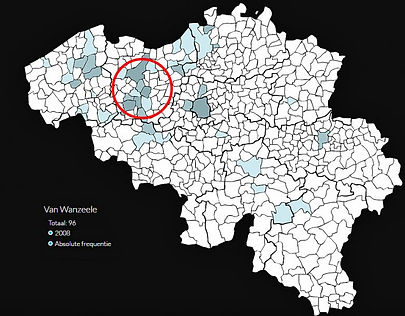
Van Wanseele or Van Wanzeele? Some ancestors are born as Van Wanzeele and die as Van Wanseele or vice versa. In other cases the marriage certificate mentions Van Wanseele but the signature of the groom is Van Wanzeele. Today both names are equally found and concentrated near Ghent in the province East Flanders, Belgium.
The most common names in Flanders are Peeters (33.000),Janssens (31.000) and Maes (25.000). With only 189 instances Van Wanseele and Van Wanzeele are uncommon names.

There is a variety of reasons why the spelling of surnames changed over generations or even in one lifetime. Some are historical, others are regional and some are purely accidental. The 19th century is a also period of transition from an oral to a written society. Furthermore in Flemish, unlike in Dutch, the pronunciation of ‘z’ and ‘s’ is very similar.
Traditional family names in Belgium can be classified in several categories of meaning. The place of origin is one such category. It is indicated by “van” , which means “from” or “of”. Most of the surnames in this category match a village, town or region’s name. This is the case for Van Wanzeele, referring to Wanzele, a town near Ghent. In most cases it means that the family was noble and ruled over the land of that area in medieval times. Unfortunatily, this is not the case for Van Wanzeele or Van Wanseele.
The nature of Flemish Dutch around 1800 is usually described as a collection of dialects. Contrary to the situation in Holland, there was no widely accepted standard Dutch which could be used for supraregional communication – in general, French was used for such purposes instead. In sum, spelling standardization was unimportant to the majority in Flanders in the 19th century.
BEFORE 1796 CATHOLIC CHURCH REGISTERS
t was not until after the Council of Trent (1545-1563) that parish priests in Europe were required to keep records of all baptisms and marriages. In the Southern Netherlands (Belgium), this recording became obligatory in 1564 but was still very irregularly applied. In their Eternal Edict (1611) the rulers of Flanders, Albert and Isabella ordered the aldermen of towns and villages throughout their reign to make copies of all church records. Thus the parish registers were preserved as two separate sources: church and magistracy. Except for some very early records, all were written in Latin.

1796 – 1805 REPUBLICAN CIVIL REGISTER
In 1795, Belgium was annexed by France. Napoleon Bonaparte instituted the civil registration of births, marriages, and deaths. Civil registration in French occurs on a town-by-town basis. Many of the earliest records from this time follow the French Revolutionary calendar established in France in October 1793 and abolished by Napoleon on January 1, 1806
Here is a handy conversion tool. I.c. l’an treize 28 thermidor = 1805 16th of August.
It was not unusual to replace formerly Latin names with French names, i.c. August for Augustus, Charles for Carolus, François for Franciscus, Louis for Ludovicus, etc.

1805 – END 19TH CENTURY OLD REGISTER
These civil records are the primary source for research after 1796. They are recorded by either the mayor himself or a government clerk within 3 days of the event. They are generally correct as far as the information goes, as the events were registered by eyewitnesses of the event. Barring spelling errors or faulty memory, civil records are as accurate as possible.
After the defeat of Napoleon at Waterloo in 1815 the country was unified with the Netherlands for 15 years before becoming an independent nation in 1830. Although French was the language of public administration and the bourgeoisie, civil records in Flanders were listed in Dutch.
